
Glossary
 Previous Question
Neptune
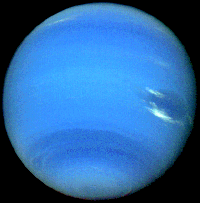
Neptune is the eighth planet from the sun and takes 165 years to orbit the sun once. Neptune is about 4 times larger than the Earth and is about 17 times as massive. Neptune was discovered on September 23, 1846 based on calculations done by the French astronomer Urbain LeVerrier and the English astronomer John Adams.
Neptune is also the Roman name for Poseidon, the god of the sea and earthquakes. Neptune was the son of Chronus and Rhea and carries the trident, a three pronged spear.
Planetary Data
| Distance from Sun | Length of Day | Length of Year | Radius | Mass |
| 30.069 AU | 16.1 hours | 164.79 years | 24,764 km | 1.02*1026 kg |
Known Satellites
| Name | Distance from Neptune | Rotational Period | Orbital Period | Radius |
| Naiad | 48,227 km | -unknown- | 0.294396 days | 33 km |
| Thalassa | 50,074 km | -unknown- | 0.311485 days | 41 km |
| Despina | 52,526 km | -unknown- | 0.334655 days | 75 km |
| Galatea | 61,953 km | -unknown- | 0.428745 days | 88 km |
| Larissa | 73,548 km | -unknown- | 0.554654 days | 97 km |
| S/2004 N1 | 104,200 km | -unknown- | 0.9362 days | 9 km |
| Proteus | 117,646 km | -unknown- | 1.122315 days | 210 km |
| Triton | 354,759 km | 5.8768541 days | 5.8768541 days | 1,352.6 km |
| Nereid | 5,513,818 km | -unknown- | 360.13619 days | 170 km |
| Halimede | 16,611,000 km | -unknown- | 1,874.8 days | 31 km |
| Sao | 22,228,000 km | -unknown- | 2,918.9 days | 22 km |
| Laomedeia | 23,567,000 km | -unknown- | 2,982.3 days | 21 km |
| Psamathe | 48,096,000 km | -unknown- | 9,074.3 days | 20 km |
| Neso | 49,285,000 km | -unknown- | 974073 days | 30 km |
Planetary and Satellite Data: NASA's Solar System Explorer
Citation and linking information
For questions about this page, please contact Steve Gagnon.